

Training Video Production: Process, Costs and Timelines
Training video production turns subject knowledge into a film or lesson that helps a defined audience perform a task. The work can include learning design, scripting, screen recording or filming, editing, accessibility, publishing and maintenance. A quote should say which of those services it includes.
For a useful estimate, specify the audience, task, format, number of lessons, languages, review process and delivery system. A finished-minute price alone cannot tell you whether two proposals cover the same job.
This guide explains the production process, gives dated examples of published prices, and provides a brief you can use with an internal team, freelancer or agency.
Choose the format around the task
| What the viewer needs to do | Format to consider | What the brief must cover |
|---|---|---|
| Follow a software workflow | Narrated screen walkthrough | Required permissions, realistic demo data, success and error states |
| Understand a concept or data flow | Animation or annotated diagram | What each element represents and how it connects to the task |
| Recognize a physical action | Filmed demonstration | Camera angles, safe procedure and expert supervision where needed |
| Handle a difficult conversation | Scenario, role-play or interactive lesson | Credible choices, feedback and an opportunity to practise |
| Learn a sequence across several sessions | Short learning path | Entry requirements, order, practice and help between lessons |
| Apply a policy | Explanation plus examples and assessment | Current policy owner, exceptions, required records and update triggers |
These formats can be combined. A screen recording may be inexpensive when the workflow is stable and ready to capture; complex demo data, localization and interface changes can make it substantial work. A compliance video also needs accurate instruction and appropriate assessment. Completion is only one possible record.
Customer and employee training share many production needs. Both benefit from clear explanations, accessible delivery and a way to check task performance. Differences come from the actual audience: customer account permissions, employee roles, commercial entitlements, confidentiality, required training and where people work. Neither audience has one universal attention span, learning platform or content lifespan.
For choosing between a recording, reference guide and live session, use the customer training strategy guide.
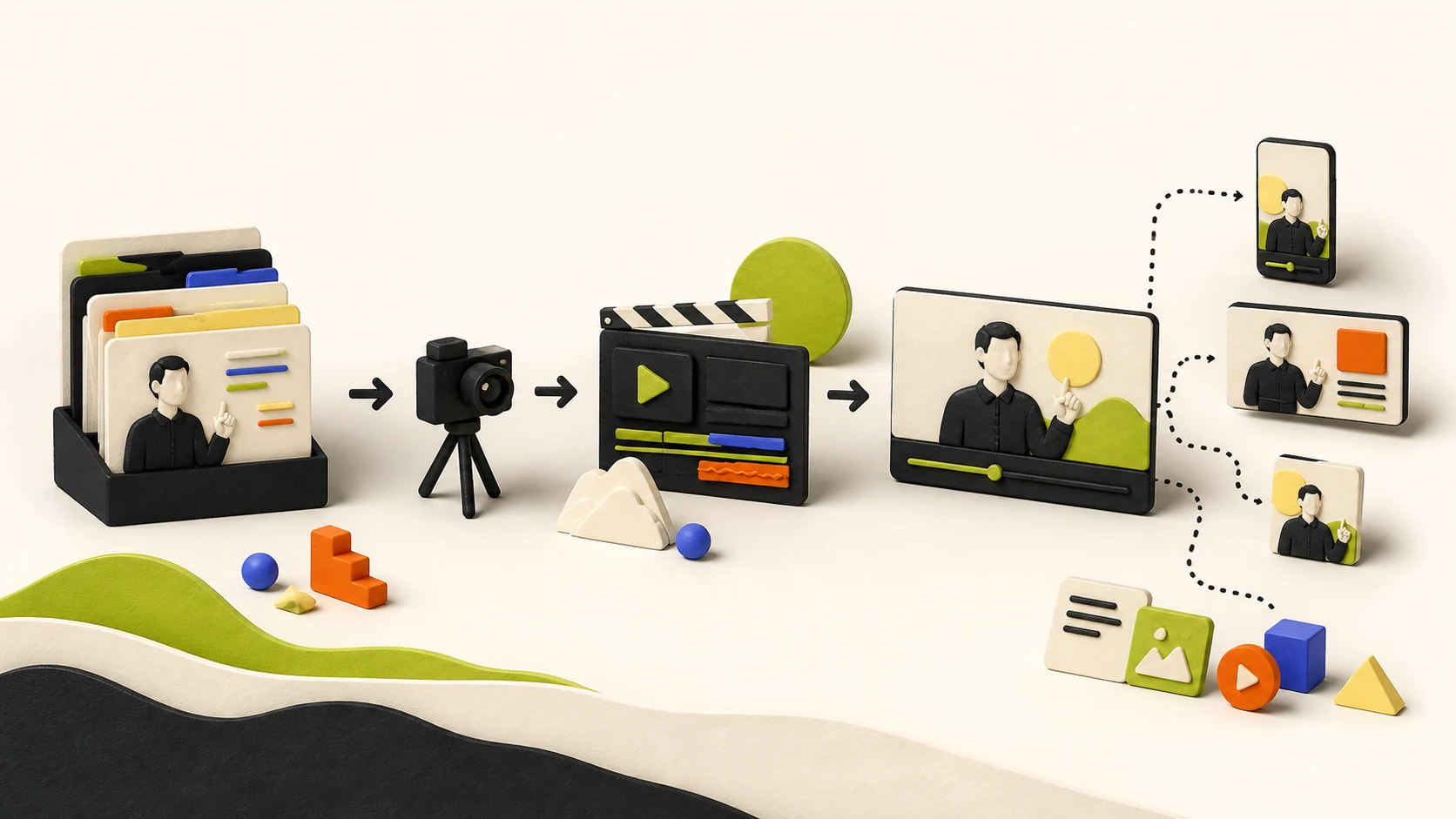
The training video production process
The following nine steps are a practical production workflow. Smaller projects may combine steps, but the decisions and responsibilities still need an owner.
1. Define the outcome and scope
Write the task in observable terms: “An account administrator can invite a colleague with the correct role and verify access.” Identify what currently prevents it. Missing permissions or a broken invitation flow need a product or account fix before a tutorial can help.
Deliverable: a brief naming the audience, outcome, starting conditions, included services and exclusions.
2. Map the learning sequence
Decide what the viewer must know first, what to demonstrate, where to practise and how to get help. Group related objectives when they form a coherent task. Separate material when audiences or prerequisites differ; there is no requirement to make one video for every objective.
Deliverable: a lesson map with estimated runtimes and the action following each lesson.
3. Write and verify the script
Assign a writer and a subject expert. Put narration beside the corresponding screen or action so reviewers can catch mismatches before recording. Include meaningful labels, common mistakes and what successful completion looks like.
For initial planning, 130-150 spoken words per minute would put three minutes of continuous narration at 390-450 words. This is arithmetic using an assumed pace, not a required delivery speed. Demonstration pauses, unfamiliar terminology and learner practice can require more time. Read the script aloud and test it against the actual task.
Deliverable: an approved script with factual questions resolved.
4. Plan the visuals and production
Choose what to record, film or animate. Establish capture dimensions, readable interface scale, voice treatment and a consistent visual style. Prepare an approved demonstration environment. Check the whole screen for personal data, confidential records, notifications and access tokens; removing a customer name alone is insufficient.
Deliverable: a storyboard or shot list, prepared environment and agreed asset permissions.
5. Record or create the material
Capture complete actions, including their results. Keep footage organized by scene and version. Record clean audio and enough context for an editor to understand a cut. For real presenters, agree usage rights and availability for corrections. Synthetic voices and likenesses also require appropriate permission and review.
Deliverable: organized footage, narration and visual assets.
6. Edit for understanding and access
Remove unnecessary waiting without hiding required steps. Keep labels readable, check audio, and use emphasis to direct attention. Review captions against the final audio, including product names and meaningful sounds. Provide a useful transcript or task reference.
Accessibility also depends on the information conveyed visually and on the player. Plan spoken descriptions of essential visual information, keyboard access and appropriate alternatives. Captions alone do not establish accessibility; W3C’s media guidance explains the relevant components.
Deliverable: a review cut and the agreed caption, transcript and alternative formats.
7. Review against acceptance criteria
An initial review can cover accuracy and sequence; a later review can cover the finished edit and delivery. This is a planning pattern, not a rule that every project needs exactly two rounds. Specify included revisions, response times, the person consolidating feedback and how errors differ from a changed brief.
Bring necessary product, policy, legal or accessibility reviewers into the relevant decisions early. An unresolved factual error must not be accepted simply because the nominal revision allowance has been used.
Deliverable: documented approval against the agreed scope and a resolved issue list.
8. Publish and test the complete experience
Test the actual player, captions, links, mobile display, login and permissions. If a learning package is required, test it in the intended LMS rather than accepting “LMS-ready” as sufficient evidence. Define which events will be collected and whether they connect to the intended task outcome.
Deliverable: working placements and a launch check. A file transfer and a live learning experience are different delivery scopes.
9. Assign maintenance
Record the product or policy version, owner, last factual check and reason to review again. A changed button label may need a small correction; a changed permission model may require a new explanation. Agree access to editable files, licensed assets, update pricing and turnaround arrangements.
Deliverable: an asset register and an update process, including removal of obsolete versions.
Training video production costs and estimates
The following are published examples in US dollars, not Corso quotations or a market-wide average. They use different units and cannot be ranked as equivalent offers.
| Source and date | Scope described by the publisher | Published figure |
|---|---|---|
| Synthesia, March 2025 | Training video, per finished minute | $1,000-$10,000 |
| D-MAK, May 2026 | Mid-tier production, per video | $8,000-$25,000 |
| D-MAK, same guide | Enterprise production, per series | $25,000-$75,000 |
| Clutch, September 2026 | Video production projects reviewed on its platform, across project types | Typically below $10,000; reported mean $42,280.92 |
Synthesia and D-MAK publish vendor guidance. Clutch draws on submitted client reviews; its pricing page does not provide a sample count for each aggregate. Its typical project description and arithmetic mean are different statistics. None establishes the price of your training project.
Ask for a total scoped price and a breakdown of optional work. Runtime helps estimate production effort, but research, filming arrangements and platform testing can matter more than the final number of minutes.
Compare the same scope
| Cost driver | Decision to make before comparing quotes |
|---|---|
| Learning design and writing | Who turns the source material into a teachable sequence? |
| Expert access | Who answers factual questions, and when? |
| Format and assets | Screen capture, filming, animation, existing materials or a combination? |
| Lessons and versions | How many distinct outputs, aspect ratios and audience variants? |
| Languages | Which translations, voice tracks, captions and local reviews are required? |
| Accessibility | Which media alternatives and player checks are included? |
| Reviews | What is included, what counts as a correction, and what changes the scope? |
| Delivery | File handoff, hosting, LMS packaging, publishing and analytics responsibilities? |
| Maintenance and rights | Editable files, third-party licenses, updates, storage and handover? |
Do not postpone an essential language or accessibility requirement until usage data appears. People excluded by the initial release may never appear in that data.
How long does production take?
There is no dependable duration based only on video length. Ask the producer to schedule the dependencies: expert access, script approval, asset preparation, recording, editing, review and delivery testing.
For a planning example, a short screen walkthrough might use the following 15-working-day schedule:
| Working days | Planned work | Dependency |
|---|---|---|
| 1-3 | Brief, workflow check and script | Expert available; demonstration environment ready |
| 4-5 | Script review and revisions | Named reviewer responds within the booked window |
| 6-8 | Capture and first edit | Approved script and stable interface |
| 9-10 | Accuracy and usability review | Representative reviewer can attempt the task |
| 11-13 | Revisions, captions and transcript | Consolidated comments and resolved factual questions |
| 14-15 | Delivery testing and launch | Access to the actual publishing destination |
This is an illustrative schedule, not a Corso delivery promise or an industry benchmark. Location filming, interactive branches, localization or additional approvals can change it substantially. If an approval is delayed by two days on the critical path, the end date may move by two days; independent work may continue in parallel.
In-house, freelancer, agency or AI-assisted production?
Choose the arrangement that supplies the capabilities and capacity the brief needs. These options overlap: internal teams and agencies can both use AI tools and specialist freelancers.
- Internal production fits recurring work when the team has time, skills and product access. Include writing, review, equipment, software and coverage during absence in the cost.
- A freelancer can cover a defined gap, such as editing, narration or learning design. Assign responsibility for the work outside that scope.
- An agency or studio can coordinate multiple production disciplines. Check its relevant examples, responsibilities and maintenance terms.
- AI-assisted tools can support drafts, narration, captions, editing or language versions. Budget for factual verification, pronunciation, permissions, accessibility and a fresh review after changes.
An AI-generated update still needs to match the real workflow and the final visuals. A subscription price excludes much of the work needed to produce an accurate lesson. Conversely, hiring a studio does not automatically produce better learning: assess the proposed work and a representative sample.
Build a business case without counting every hour as cash saved
Suppose 40 new accounts each quarter receive 1.5 staff hours of repeated explanation. That is 40 × 1.5 × 4 = 240 hours per year.
If a pilot suggests recordings could replace half of that work, the potential release is 120 hours. If maintenance and additional help take 30 hours annually, the net release is 90 hours. At an illustrative $80 loaded hourly cost, that is $7,200 of staff capacity.
It is not automatically $7,200 less expenditure. Count cash savings only where spending actually changes. Include production costs and examine whether learners still complete the task correctly. Use the customer education KPI guide to separate learning, product outcomes, capacity and financial returns.
A brief you can send to a production company
- Audience and starting point: [role, access, experience and language]
- Task and success check: [what the person must do and how it is verified]
- Current difficulty: [observations, questions, errors or task data]
- Source material and expert: [approved references and named reviewer]
- Proposed outputs: [lessons, approximate runtime, formats and variants]
- Delivery and access: [help centre, product, LMS or other destination]
- Required checks: [accuracy, accessibility, permissions and platform testing]
- Schedule: [launch need, review windows and known dependencies]
- Commercial terms: [budget, revisions, usage rights, editable files and updates]
- Measurement: [baseline, launch date, follow-up window and owner]
Compare the responses against this same brief. An agency that retains project files may still offer suitable licensed use and maintenance; decide whether those terms meet your needs before signing. A separately quoted update can also be reasonable if the process and basis are clear.
How Corso approaches a first project
Corso’s Customer Adoption Pilot focuses on one audience and one valuable workflow. The scope combines diagnosis, learning architecture, production, a launch-ready handoff and recommendations for subsequent work. The exact lesson count, runtime, price and schedule need to be agreed for that project.
Our portfolio contains original demonstrations: a two-part HRIS onboarding series, workflow enablement examples and an interactive embassy-interview lesson. They show production and learning design choices. They are not presented as measured client case studies.
Bring the workflow, the intended audience and the point where people struggle. Discuss a scoped pilot.
Frequently asked questions
How much does a three-minute training video cost?
Three minutes does not define the scope. A ready-to-record software task and a filmed scenario with several actors can share that runtime while requiring very different work. Use the dated price examples above for context and request a quote covering writing, production, reviews, delivery and updates.
Does a training video need an LMS?
No. A help page, product interface or approved video platform may meet the need. Use an LMS when enrollment, pathways, assessments, records or account reporting justify it. Test learner access and the reporting you actually require.
Are captions and a transcript enough?
They are useful, but not necessarily sufficient. Essential visual information may need description, and the player and any interactions need accessibility checks. Define the requirements before production.
How do we know the video helped?
Check whether the intended audience can complete the task, the mistakes they make and the support they still need. Views and completion explain exposure; they do not prove learning or revenue impact. Compare equivalent groups or periods and record other changes that could affect the result.